Supplement Timing and Frequency: Complete Evidence-Based Guide
Supplement timing affects absorption 50%+! Iron + calcium = compete. Fat-soluble vitamins need fats. Thyroid med spacing critical. Complete timing guide.
by WellnessWithForever
2/25/202617 min read
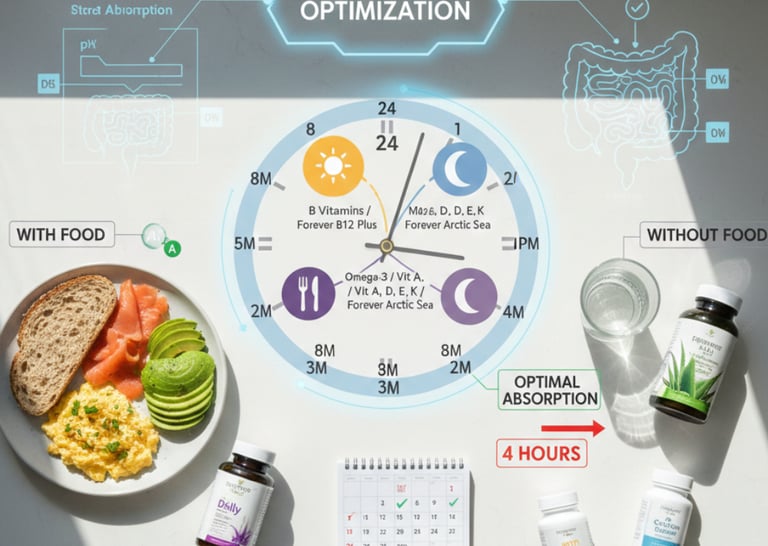
Supplement Timing and Frequency: Complete Evidence-Based Guide
By WellnessWithForever 25 February 2026: This post might contain affiliate links.
You've invested in quality supplements, but are you taking them at the right times to maximize absorption and effectiveness? Research reveals that WHEN and HOW you take supplements can be just as important as WHICH supplements you take. Poor timing can reduce absorption by 50% or more, waste money on supplements your body doesn't absorb, and even cause side effects or interactions that proper timing would prevent.
This comprehensive guide examines evidence-based strategies for supplement timing and frequency, explaining which supplements to take with meals vs. empty stomach, morning vs. evening, and which combinations to avoid. We'll cover Forever Living products specifically and provide practical protocols you can implement immediately.
Important Medical Disclaimer: Supplement timing and interactions can significantly affect medication absorption and effectiveness. Some supplement-medication interactions are dangerous (blood thinners + vitamin E/K, thyroid medication + calcium/iron, etc.). NEVER adjust medication timing without consulting your healthcare provider. This guide provides general information but does NOT replace personalized medical advice. Certain medical conditions require specific supplement timing protocols—work with your doctor. Pregnant/breastfeeding women, children, elderly, and people with medical conditions or taking medications should consult healthcare providers before implementing any supplement schedule. This information is educational and does not replace professional medical guidance.
Key Takeaways
Supplement timing affects absorption, effectiveness, and side effect risk
Fat-soluble vitamins (A, D, E, K) require dietary fat for absorption
Calcium and iron compete—space 4+ hours apart
Some supplements energizing (take morning), others relaxing (take evening)
Thyroid medication requires 4-hour separation from calcium, iron, supplements
Medication-supplement interactions critical safety consideration
Consistency more important than perfect timing for most supplements
Why Timing Matters: The Science
Evidence quality: STRONG to VERY STRONG for specific nutrient interactions
Absorption Competition
The problem: Certain nutrients compete for the same absorption pathways in your intestines.
Key examples:
Calcium vs. Iron:
Evidence: VERY STRONG
Both absorbed via similar mechanisms in small intestine
Calcium significantly inhibits iron absorption
Impact: Taking together can reduce iron absorption by 50-60%
Solution: Space 4+ hours apart
Calcium vs. Zinc:
Evidence: MODERATE to STRONG
High calcium doses (>800 mg) may impair zinc absorption
Solution: Take at different meals or space several hours apart
Iron vs. Zinc:
Evidence: MODERATE
May compete for absorption at high doses
Solution: Space apart if taking therapeutic doses
Fat-Soluble vs. Water-Soluble Vitamins
Fat-soluble vitamins (A, D, E, K):
Evidence: VERY STRONG for fat requirement
REQUIRE dietary fat for absorption
Without fat, absorption dramatically reduced (as low as 10-20%)
Best timing: With largest meal containing fat (breakfast with eggs/avocado, dinner with salmon, etc.)
Water-soluble vitamins (B, C):
Don't require fat
Absorbed well with or without food
Flexibility: Can take anytime
Some better with food (reduces stomach upset)
pH and Stomach Acid Requirements
Nutrients requiring stomach acid:
Iron (non-heme):
Evidence: STRONG
Requires acidic environment for optimal absorption
Best timing: Empty stomach (most acidic)
Alternative: With vitamin C on empty stomach (enhances absorption)
If causes nausea: Take with small amount of food (sacrifice some absorption for tolerability)
Calcium carbonate:
Evidence: STRONG
Requires stomach acid for dissolution
Best timing: WITH meals (stomach produces acid)
Calcium citrate:
Doesn't require stomach acid
Can take anytime (with or without food)
Nutrients sensitive to stomach acid:
Probiotics:
Evidence: MODERATE to STRONG
Stomach acid kills many probiotic bacteria
Best timing: Empty stomach (less acid) or with meals (food buffers acid)
Product-specific recommendations vary
Circadian Rhythm and Physiological Timing
Energizing supplements—take MORNING:
B vitamins:
Evidence: MODERATE (based on energy production role)
Involved in energy metabolism
May interfere with sleep if taken late
Best timing: Morning or early afternoon
Vitamin D:
Evidence: LIMITED but suggestive
Some report sleep disruption with evening dosing
May affect melatonin
Best timing: Morning with breakfast (also ensures taken with fat)
Relaxing supplements—take EVENING:
Magnesium:
Evidence: MODERATE for relaxation effect
Promotes muscle relaxation
May support sleep quality
Best timing: Evening or before bed
Calcium:
Evidence: LIMITED for sleep support
Some research suggests evening calcium supports sleep
Best timing: Evening (if not taking with iron)
Fat-Soluble Vitamins: Take with Dietary Fat
Evidence quality: VERY STRONG
Vitamins A, D, E, K
Why fat required: These vitamins dissolve in fat, not water. Without dietary fat present:
Absorption reduced to 10-20% of potential
Most of supplement passes through unabsorbed
Waste of money, minimal benefit
How much fat needed:
Research shows 10-15 grams of fat per meal adequate
Examples of fat-containing meals:
Eggs with avocado (15-20g fat)
Salmon with olive oil dressing (20-30g fat)
Nuts/nut butter with meal (10-15g fat)
Full-fat yogurt (8-10g fat)
Optimal timing: Take with your LARGEST meal containing fat (typically breakfast or dinner for most people)
Forever Living Fat-Soluble Supplements
Forever Daily:
Contains vitamins A, D, E, K (plus other nutrients)
Timing: With breakfast or dinner (meal containing fat)
Frequency: 4 tablets daily (can split: 2 morning, 2 evening with meals, OR all 4 with one meal)
Forever Arctic Sea:
Provides omega-3 EPA/DHA (fats themselves)
Also contains vitamins A and E
Timing: With meals
Benefit: Taking with food reduces fishy aftertaste
Frequency: 2-4 softgels daily (can split or take together with meal)
Vitamin D (standalone):
Timing: With breakfast containing fat (eggs, avocado, nut butter)
Frequency: Once daily
Vitamin E (standalone):
Timing: With meal containing fat
Frequency: Once daily
Water-Soluble Vitamins: Flexible Timing
Evidence quality: MODERATE to STRONG
B Vitamins
Absorption: Don't require fat, absorbed well with or without food
Energy consideration:
B vitamins involved in energy metabolism
Some report feeling energized
Best timing: Morning or early afternoon (avoid before bed)
Stomach tolerance:
May cause nausea on empty stomach (individual variation)
If nausea: Take with food
Forever B12 Plus:
Contains B12, B6, folate
Timing: Morning (sublingual—dissolve under tongue)
Frequency: Once daily
Can take with or without food
Forever Daily (contains B vitamins):
Timing: With breakfast (covers fat-soluble vitamins too)
Frequency: 4 tablets daily
Vitamin C
Absorption:
Water-soluble, doesn't require fat
Well-absorbed with or without food
High doses (>500 mg) absorbed less efficiently (divide doses)
Stomach tolerance:
High doses may cause upset on empty stomach
Best timing: With food if taking high doses
Special consideration: Take WITH iron if supplementing iron (vitamin C dramatically enhances iron absorption)
Forever Absorbent-C:
Sustained-release formula
Timing: With or without food (sustained release provides flexibility)
Frequency: As directed on label (typically 1-2 tablets daily)
Minerals: Timing Critical for Absorption
Evidence quality: VERY STRONG for mineral interactions
Calcium
Absorption:
Absorbed best in doses ≤500 mg at a time
Higher doses: Absorption efficiency drops
Strategy: If taking 1,000 mg daily, split into 500 mg doses
Types:
Calcium carbonate:
Requires stomach acid
Timing: WITH meals
Calcium citrate:
Doesn't require acid
Timing: Anytime (with or without food)
CRITICAL INTERACTIONS:
Calcium BLOCKS iron absorption:
DO NOT take together
Space 4+ hours apart
Example: Iron at breakfast, calcium at dinner
Calcium BLOCKS thyroid medication:
DO NOT take within 4 hours of thyroid medication
Example: Thyroid med upon waking, calcium at lunch/dinner
Calcium and vitamin D synergy:
Take together (vitamin D enhances calcium absorption)
Timing: With meal containing fat (for vitamin D)
Forever Living calcium sources:
Forever Daily contains calcium
Timing: With meals (away from iron, thyroid medication)
Iron
Evidence quality: VERY STRONG
Absorption:
BEST: Empty stomach (most acidic)
ENHANCER: Vitamin C dramatically increases absorption
INHIBITORS: Calcium, coffee, tea, dairy, high-fiber foods
Optimal protocol: Empty stomach with vitamin C (orange juice or Forever Absorbent-C)
If causes nausea:
Take with small amount of food (sacrifice some absorption)
Avoid calcium, dairy, coffee with iron dose
CRITICAL SPACING:
Iron and calcium: 4+ hours apart
Iron and thyroid medication: 4+ hours apart
Iron and coffee/tea: 2+ hours apart
Forever Daily (contains iron):
Timing: If taking alone, morning empty stomach
Reality: Most people take with meals for convenience
Compromise: Take with non-dairy, low-calcium meal
Therapeutic iron (if supplementing additionally):
Timing: Empty stomach, 1 hour before breakfast with vitamin C
Frequency: Once daily (or as prescribed)
Separate from: Forever Daily if it contains calcium
Magnesium
Absorption:
Well-absorbed with or without food
Some forms better absorbed (magnesium glycinate, citrate > oxide)
Physiological timing:
Relaxing effect: Many report muscle relaxation, improved sleep
Best timing: Evening or before bed
Digestive effects:
Magnesium has laxative effect (especially citrate, oxide)
If this occurs: Reduce dose or switch to glycinate form
Interactions:
High calcium doses may impair magnesium absorption (space apart if both high-dose)
Forever Daily (contains magnesium):
Timing: With evening meal (covers fat-soluble vitamins, provides evening magnesium)
Zinc
Absorption:
Best on empty stomach BUT often causes nausea
Compromise: Take with food (reduces nausea, still reasonably absorbed)
Interactions:
Competes with iron, calcium, copper at high doses
If taking therapeutic zinc: Space 2+ hours from iron, calcium
Food considerations:
High phytate foods (whole grains, legumes) may reduce absorption
If supplementing zinc: Take between meals if tolerated
Forever Daily (contains zinc):
Timing: With meals
Omega-3 Fatty Acids: With Meals
Evidence quality: STRONG
Why Take with Food
Absorption:
Fats absorbed better with meals (especially meals containing other fats)
Food stimulates bile release (needed for fat digestion)
Reduces side effects:
Fishy aftertaste/burps: Dramatically reduced when taken with food
Taking on empty stomach increases fishy burps
Best meal: Any meal, but particularly effective with breakfast or dinner
Tip to prevent fishy burps:
Take with meals
Freeze capsules (slows release in stomach)
Take with largest meal
Forever Arctic Sea:
Timing: With meals (breakfast, lunch, or dinner)
Frequency: 2-4 softgels daily (can split or take together)
Tip: Many find taking all softgels with dinner prevents any fishy taste
Probiotics: Strategic Timing for Survival
Evidence quality: MODERATE to STRONG
The Stomach Acid Challenge
Problem: Stomach acid kills many probiotic bacteria before they reach intestines
Timing strategies:
Empty stomach (30 min before meals):
Evidence: MODERATE
Less stomach acid present
Some research supports this timing
With meals:
Evidence: MODERATE
Food buffers acid
Some research supports this timing
The reality: Research shows BOTH approaches can work. Product-specific formulations matter more than timing.
Enteric-coated probiotics:
Protective coating survives stomach acid
Can take anytime
Practical recommendation: Follow product-specific instructions, as different probiotics formulated differently.
Digestive Enzymes and Digestive Support
Evidence quality: STRONG for timing requirement
Forever Active Probiotic (if using)
Timing: Product-specific—check label for manufacturer recommendation
Frequency: Daily for maintenance, or as directed
General Digestive Enzyme Timing
When to take: IMMEDIATELY BEFORE OR WITH MEALS (ideally right before first bite)
Why timing critical:
Enzymes work on food you're currently eating
Taking between meals or after meals less effective
Which meal:
Take with largest meal or meals causing digestive discomfort
Can take with all meals if needed
Forever Aloe Vera Gel (digestive support):
Timing: Empty stomach (30 minutes before meals) OR before bed
Frequency: 2-4 oz twice daily
Rationale: Empty stomach allows aloe to coat digestive tract
Medication-Supplement Interactions: Critical Spacing
Evidence quality: VERY STRONG for major interactions
Thyroid Medication (CRITICAL!)
Medications: Levothyroxine (Synthroid, Levoxyl), liothyronine
THE RULE: Take thyroid medication ALONE on empty stomach, 30-60 minutes before food or other supplements
THEN wait 4+ hours before:
Calcium supplements
Iron supplements
Multivitamins containing calcium/iron
Magnesium (2+ hours minimum)
Soy products
High-fiber foods
Why so strict: Calcium, iron, magnesium, fiber all significantly reduce thyroid medication absorption (by 40-50% or more)
Practical protocol:
6:00 AM: Thyroid medication on empty stomach
6:30-7:00 AM: Breakfast (no calcium/iron supplements)
10:00 AM or later: Forever Daily (contains calcium/iron)
OR: Take Forever Daily with dinner (well separated from morning thyroid med)
Reality check: If you're taking thyroid medication and supplements, you MUST space them. Non-negotiable.
Blood Thinners (Warfarin, etc.)
Supplements to AVOID or use with CAUTION:
Vitamin K:
CRITICAL: Vitamin K counteracts warfarin
Don't avoid entirely BUT be CONSISTENT
Sudden changes in vitamin K intake dangerous
Strategy: Maintain consistent vitamin K intake daily
Vitamin E (high doses):
May increase bleeding risk
Limit: <400 IU daily (or discuss with doctor)
Omega-3s (high doses):
Mild blood-thinning effect
Inform doctor about omega-3 use
Usually safe at typical doses (1,000-2,000 mg)
Garlic, ginkgo, other herbal supplements:
May increase bleeding risk
Discuss with healthcare provider
IF YOU TAKE BLOOD THINNERS: Inform your doctor about ALL supplements, maintain consistency, never stop/start supplements without medical guidance.
Diabetes Medications
Supplements affecting blood sugar:
Chromium:
May lower blood sugar
Monitor glucose closely
May need medication adjustment
Omega-3s:
Generally safe
Some studies show modest blood sugar effects
Alpha-lipoic acid, cinnamon:
May affect blood sugar
Discuss with doctor
IF YOU TAKE DIABETES MEDICATIONS: Monitor blood glucose when starting supplements, report any changes to healthcare provider.
Blood Pressure Medications
Supplements affecting blood pressure:
Calcium (high doses):
May lower blood pressure (additive effect with medications)
Usually not problematic but monitor
Magnesium:
May lower blood pressure
Usually beneficial but monitor
CoQ10:
May lower blood pressure
Typically safe
IF YOU TAKE BLOOD PRESSURE MEDICATIONS: Monitor blood pressure, report significant changes to healthcare provider.
Antidepressants
St. John's Wort:
DANGEROUS interaction with many medications including antidepressants (serotonin syndrome risk)
Also reduces effectiveness of birth control, blood thinners, others
NEVER combine with antidepressants without explicit medical supervision
Statins (Cholesterol Medications)
CoQ10:
Statins deplete CoQ10
Supplementation often beneficial (may reduce muscle pain)
No known negative interaction
Red yeast rice:
Contains natural statin
Don't combine with statin medications without medical supervision
Creating Your Personalized Supplement Schedule
Morning Protocol
Upon waking (empty stomach):
Thyroid medication (if applicable) - ALONE
Wait 30-60 minutes
Breakfast (with meal containing fats):
Forever Daily (2-4 tablets)
Vitamin D (if standalone)
Forever Arctic Sea (1-2 softgels)
Forever B12 Plus (sublingual)
Probiotics (if product recommends with food)
Mid-morning (if needed):
Any supplements missed at breakfast
Iron (if taking—empty stomach with vitamin C, 4+ hours from thyroid medication)
Afternoon Protocol
Lunch (optional):
Forever Arctic Sea (if splitting dose)
Any supplements better tolerated with food
Mid-afternoon:
B vitamins (if not taken at breakfast and want energy support)
Evening Protocol
Dinner (with meal containing fats):
Forever Daily (if splitting dose: 2 tablets at dinner)
Forever Arctic Sea (1-2 softgels—if this is when you take full dose)
Calcium (if supplementing—away from iron)
Fat-soluble vitamins
Before bed:
Magnesium (relaxing effect)
Forever Aloe Vera Gel (if taking second dose of day)
Probiotics (if product recommends empty stomach)
Example Schedules
Schedule 1: Thyroid Medication User
6:00 AM: Thyroid medication (ALONE, empty stomach)
7:00 AM: Breakfast with fats (eggs, avocado)
Forever B12 Plus (sublingual)
Vitamin D
12:00 PM: Lunch
Forever Arctic Sea (2 softgels)
6:00 PM: Dinner with fats
Forever Daily (4 tablets)
Forever Absorbent-C
10:00 PM: Before bed
Magnesium
Forever Aloe Vera Gel
Schedule 2: Iron Supplementation User
7:00 AM: Empty stomach
Iron + Forever Absorbent-C (vitamin C enhances absorption)
8:00 AM: Breakfast with fats (1 hour after iron)
Forever Daily (contains calcium—separated from iron!)
Forever Arctic Sea
Forever B12 Plus
6:00 PM: Dinner
Forever Aloe Vera Gel (30 min before)
10:00 PM: Before bed
Magnesium
Schedule 3: Simple Maintenance (No Special Medications)
8:00 AM: Breakfast with fats
Forever Daily (4 tablets)
Forever B12 Plus (sublingual)
Forever Arctic Sea (2-4 softgels)
6:00 PM: Dinner
Forever Aloe Vera Gel (30 min before)
Forever Absorbent-C
10:00 PM: Before bed
Magnesium (if supplementing)
Practical Implementation Tips
Start Simple
Don't overcomplicate:
Consistency more important than perfect timing for MOST supplements
Start with basic schedule, refine as needed
Priority spacing:
Thyroid medication: STRICTLY space 4+ hours from calcium/iron/supplements
Iron and calcium: ALWAYS space 4+ hours apart
Fat-soluble vitamins: Always take with fats
Everything else: Less critical, focus on consistency
Use Tools
Pill organizers:
Weekly organizers with AM/PM compartments
Pre-load week's supplements
Reduces decision fatigue
Phone reminders:
Set alarms for supplement times
Link to meals (easier to remember)
Tracking apps:
Many apps available for supplement tracking
Helpful initially while establishing routine
Build Habits
Link to existing routines:
Breakfast supplements with morning coffee/breakfast prep
Evening supplements with dinner or bedtime routine
Make visible:
Keep supplements on counter (where you'll see them)
Next to coffee maker, by bedside, etc.
Prepare night before:
Load next day's supplements into small container
Reduces morning rush decisions
Adjust Based on Response
Monitor how you feel:
If B vitamins interfere with sleep: Move to morning
If magnesium causes drowsiness: Move to evening
If iron causes nausea: Take with food despite reduced absorption
Digestive tolerance:
If any supplement causes upset: Try with food
If persists: Try different form or timing
If continues: Consult healthcare provider
Special Populations
Pregnancy and Breastfeeding
Prenatal vitamins:
Timing: With food (reduces nausea)
Frequency: Once daily
Iron in prenatals: If causes constipation, increase fluids/fiber
Additional supplements:
Omega-3s (DHA): With meals
Calcium (if needed): Separate from prenatal if it contains iron
Consult OB-GYN about all supplements
Children
Follow pediatrician guidance:
Age-appropriate dosing
Child-specific formulations
Timing based on meal schedules
General principles:
With meals (better tolerance)
Chewable/liquid forms often easier
Avoid before bed if energizing
Elderly
Considerations:
Multiple medications common (interaction risk higher)
Swallowing difficulties (liquid/sublingual options)
May need help organizing supplements
Work with healthcare team:
Review all supplements with doctor/pharmacist
Check medication interactions
Simplify schedule as much as possible
Athletes
Timing around training:
Pre-workout (if desired):
B vitamins (energy support)
Caffeine (if using)
Post-workout:
Protein (Forever Lite Ultra if using)
Omega-3s (anti-inflammatory)
General:
Spread supplements throughout day
Stay hydrated
Consider timing around training schedule
Frequently Asked Questions
Can I take all my supplements at once?
You CAN take many supplements together, but certain combinations should be AVOIDED. Safe to take together: Most vitamins (fat-soluble with fat-soluble, water-soluble together), Forever B12 Plus with Forever Daily, Forever Arctic Sea with other supplements. SPACE APART: Iron and calcium (4+ hours), iron/calcium and thyroid medication (4+ hours), high doses of zinc and copper (compete for absorption). For simplicity, many people take a multivitamin (Forever Daily) + B12 + omega-3s all with breakfast—this works well. Just ensure you're taking fat-soluble vitamins with fats and spacing iron/calcium if taking both. HOWEVER, if you're taking therapeutic doses of specific minerals or have medications, more careful spacing may be needed. When in doubt, consult healthcare provider or pharmacist.
Does it matter if I miss a dose?
Missing occasional doses NOT a major problem for most supplements (unlike medications). Nutrients build up in your body over time, so single missed doses don't significantly impact nutritional status. HOWEVER, consistency matters for optimal benefits. If you miss a dose: Just take your next dose at the regular time (don't double up to "make up" for missed dose—can cause side effects, especially fat-soluble vitamins and minerals). If you're missing doses frequently (more than 1-2 per week), you may not achieve optimal benefits. Strategies to improve consistency: pill organizers, phone reminders, linking to meals, keeping supplements visible. For therapeutic supplementation (treating deficiency), consistency more critical—try to take daily without missing.
Should I take supplements with hot or cold beverages?
Temperature generally DOESN'T significantly affect most supplement absorption. You can take supplements with water (any temperature), coffee, tea, juice. EXCEPTIONS: Probiotics—avoid very hot beverages (heat kills beneficial bacteria), take with room temperature or cool liquids. Enzymes—very high heat may denature some enzymes, room temperature preferred. HOWEVER, beverage TYPE matters more than temperature: Avoid taking iron with coffee/tea (tannins inhibit absorption), take with water or juice. Avoid calcium supplements with high-oxalate beverages (spinach smoothies, etc.). Take iron with vitamin C-rich juice (orange juice enhances absorption). General recommendation: Plain water works well for all supplements, avoiding any potential interactions.
Can I take supplements on an empty stomach if the label says "with food"?
This depends WHY the label recommends food. Fat-soluble vitamins (A, D, E, K): NEED food containing fat for absorption—taking on empty stomach dramatically reduces absorption (waste of money). Minerals (iron exception), probiotics: CAN be taken on empty stomach BUT may cause nausea—"with food" recommendation is for TOLERANCE, not absorption. If you tolerate empty stomach, absorption may actually be BETTER for some. B vitamins, multivitamins: "With food" usually for tolerance—can cause nausea on empty stomach for some people. If you tolerate empty stomach, likely fine. RECOMMENDATION: If label says "with food" and you have no tolerance issues on empty stomach, for most supplements it's fine. BUT for fat-soluble vitamins, taking with fat-containing meal is ESSENTIAL for absorption. When in doubt, follow label instructions (manufacturers have reasons for recommendations).
How long should I wait between taking different supplements?
This depends on which supplements. NO WAITING needed for: Most vitamins together (water-soluble with water-soluble, fat-soluble with fat-soluble at a meal with fats), omega-3s with other supplements, most supplements with each other. WAIT 2+ HOURS for: Iron and coffee/tea, zinc and copper (high doses). WAIT 4+ HOURS for: Iron and calcium (strongly compete—space apart!), iron/calcium and thyroid medication (critical!), calcium and zinc (high doses). PRACTICAL APPROACH: Take most supplements together with breakfast (fat-soluble vitamins, B vitamins, multivitamin, omega-3s). Space iron (empty stomach, morning) from calcium-containing supplements (evening). If taking thyroid medication, that's always alone (30-60 min before any food/supplements), then wait 4+ hours before calcium/iron supplements. This isn't overly complicated—just a few key interactions to remember.
Should I take breaks from supplements or cycle them?
For MOST supplements, continuous daily use is appropriate and SAFE. No need to "cycle" or take breaks. Exceptions/considerations: Fat-soluble vitamins (A, D, E, K): Monitor levels periodically, as they accumulate in body (though toxicity rare at recommended doses). If levels get too high, reduce dose (don't need breaks—just adjust dose). Iron: If supplementing for deficiency, retest levels after 3-6 months. Once replenished and you're not losing iron (heavy periods, etc.), may be able to stop. Don't continue indefinitely without monitoring. Herbs/botanicals: Some practitioners recommend cycling, though evidence limited. General nutrients (B vitamins, vitamin C, magnesium, calcium, omega-3s): Continuous use safe and beneficial. Your body uses these nutrients daily. "Breaks" don't provide benefits and may allow deficiencies to develop. BOTTOM LINE: Continue evidence-based supplementation consistently. Monitor levels of nutrients that accumulate (vitamin D, iron) and adjust doses as needed, but "cycling" or taking breaks from foundational nutrients isn't necessary or beneficial.
What if I'm taking 10+ supplements—how do I organize timing?
Start by GROUPING supplements by timing requirements: GROUP 1 (Morning with breakfast with fats): Fat-soluble vitamins, multivitamins, B vitamins, omega-3s, most supplements. GROUP 2 (Empty stomach morning): Iron (with vitamin C), thyroid medication (if applicable), probiotics (if product specifies). GROUP 3 (Evening with dinner): Calcium (if taking), additional fat-soluble vitamins, omega-3s (if splitting dose). GROUP 4 (Before bed): Magnesium (relaxing effect), probiotics (if product specifies). SIMPLIFICATION STRATEGIES: Use comprehensive multivitamin (Forever Daily) instead of multiple individual vitamins—reduces pill count. Take omega-3s, B12, and other "flexible timing" supplements all with breakfast (simplifies schedule). Only space the CRITICAL pairs (iron/calcium, thyroid medication/everything). TOOLS: Weekly pill organizer with AM/PM compartments—pre-load week's supplements. Phone reminders for each timing group. Most people can consolidate 80% of supplements to one or two times daily (breakfast and/or dinner), with only special cases (iron, thyroid medication) requiring different timing.
Do I need to take Forever Daily at a specific time?
Forever Daily contains both fat-soluble vitamins (A, D, E, K) and other nutrients, so BEST timing is WITH A MEAL CONTAINING FATS (breakfast with eggs/avocado OR dinner with salmon/olive oil, etc.). This ensures optimal absorption of fat-soluble vitamins. You CAN split the dose: 2 tablets with breakfast, 2 with dinner (spreads nutrient delivery throughout day, some prefer this). OR take all 4 tablets with one meal (simpler, single reminder). AVOID: Taking on empty stomach (fat-soluble vitamins won't absorb well). CRITICAL SPACING: If you take THYROID MEDICATION: Wait 4+ hours after thyroid med before Forever Daily (contains calcium and iron which block thyroid medication absorption). If you take therapeutic IRON separately: Space Forever Daily (contains calcium) 4+ hours from iron dose. Otherwise, timing is FLEXIBLE based on your meal schedule and preferences. Consistency (same time daily) matters more than exact timing for most people.
Can supplement timing affect sleep?
YES, certain supplements can affect sleep if taken at wrong time. ENERGIZING (take MORNING/EARLY AFTERNOON, avoid before bed): B vitamins (involved in energy production—some report difficulty sleeping if taken evening), vitamin D (some report sleep disruption with evening dosing, though evidence limited), iron (some report stimulating effect). RELAXING (can take EVENING/BEFORE BED): Magnesium (promotes muscle relaxation, may support sleep quality), calcium (some evidence for sleep support, though limited). NEUTRAL (take anytime based on convenience): Vitamin C, omega-3s, most minerals, probiotics. INDIVIDUAL VARIATION: Some people take B vitamins at night without issues, others find them energizing. Pay attention to YOUR response. If you notice sleep disruption after starting supplement, try taking it earlier in day. If taking multiple supplements and unsure which is problematic, eliminate suspects one at a time to identify culprit.
What if I forget if I took my supplements?
This is common! Strategies to PREVENT this: Pill organizers (most effective—if compartment is empty, you took it), phone reminders with checkbox to mark completion, tracking apps, remove bottle from usual spot after taking (visual cue). IF YOU'RE UNSURE whether you took supplements: For MOST supplements (vitamins, minerals at typical doses): If unsure, SKIP that dose rather than risking double dose. Missing one dose not harmful, but doubling fat-soluble vitamins or minerals like iron can cause side effects. Next dose take at regular time. For MEDICATIONS (not just supplements): Follow medication-specific guidance from your doctor. If happens frequently: Invest in good pill organizer system (weekly organizer with AM/PM compartments most effective). Pre-load week's supplements on Sunday, then each day is obvious (if compartment still full, you haven't taken it). This solves the "did I take it?" problem completely.
Conclusion
Supplement timing and frequency significantly affect absorption, effectiveness, and safety. While the science can seem complex, a few key principles guide optimal supplementation: fat-soluble vitamins (A, D, E, K) REQUIRE dietary fat for absorption—always take with meals containing fats; calcium and iron compete strongly—space 4+ hours apart; thyroid medication requires strict spacing—take alone 30-60 minutes before food, then wait 4+ hours before calcium/iron supplements; medication-supplement interactions can be dangerous—inform healthcare providers about all supplements and follow spacing requirements; and consistency matters more than perfect timing for most supplements.
Forever Living products fit easily into evidence-based timing protocols. Forever Daily (comprehensive multivitamin) works best with meals containing fats, taken as 4 tablets once daily OR split 2+2 at breakfast and dinner. Forever B12 Plus (sublingual B vitamins) is flexible—morning preferred for energy support. Forever Arctic Sea (omega-3s) should be taken with meals to enhance absorption and reduce fishy aftertaste, 2-4 softgels daily with one meal or split across meals. Forever Aloe Vera Gel is best on empty stomach (30 minutes before meals or before bed), 2-4 oz twice daily.
The benefits of proper supplement timing include: maximized absorption and bioavailability (getting full value from supplements), reduced side effects (nausea, stomach upset, sleep disruption), prevention of nutrient competition (iron and calcium properly spaced), safe medication interactions (thyroid medication, blood thinners properly separated from supplements), and optimal physiological timing (energizing supplements morning, relaxing supplements evening).
Start simple: take most supplements together with breakfast containing fats (covers fat-soluble vitamins, simplifies schedule), space the critical pairs (iron/calcium, thyroid medication/supplements), and build consistency before worrying about perfect optimization. Use tools (pill organizers, phone reminders, tracking apps) to support adherence. Monitor your response and adjust timing based on tolerance and effects.
Remember: the BEST supplement schedule is one you'll actually follow consistently. Perfect timing doesn't matter if you're missing doses. Start with a simple, sustainable schedule prioritizing critical interactions, then refine based on your individual response and lifestyle. Work with healthcare providers to ensure your supplement timing complements your medications and health conditions safely.
Sources and References
National Institutes of Health Office of Dietary Supplements. "Dietary Supplements: What You Need to Know." https://ods.od.nih.gov/
American Journal of Clinical Nutrition. "Calcium supplementation and its interaction with iron absorption." https://academic.oup.com/ajcn
Journal of the Academy of Nutrition and Dietetics. "Nutrient Timing and Supplementation Strategies." https://www.jandonline.org/
National Library of Medicine. "Drug-Nutrient Interactions: A Review." https://pubmed.ncbi.nlm.nih.gov/
American Thyroid Association. "Thyroid Medication and Supplement Interactions." https://www.thyroid.org/
Journal of Clinical Endocrinology & Metabolism. "Levothyroxine absorption and calcium/iron interference." https://academic.oup.com/jcem
Institute of Medicine. "Dietary Reference Intakes for Calcium and Vitamin D." https://www.nap.edu/
British Journal of Nutrition. "Fat-soluble vitamin absorption and dietary fat." https://www.cambridge.org/core/journals/british-journal-of-nutrition
U.S. Food and Drug Administration. "Medication and Supplement Interactions." https://www.fda.gov/
Journal of the American College of Nutrition. "Timing of Nutrient Intake and Bioavailability." https://www.tandfonline.com/loi/uacn20
About the Author
Naddy is a wellness enthusiast and content creator behind Wellness With Forever. She focuses on simple, practical tips to support a healthy lifestyle through nutrition, movement, and mindful habits.
Disclaimer
This information is for educational purposes only and does not replace professional medical advice. Supplement-medication interactions can be dangerous—NEVER adjust medication timing without consulting healthcare providers. Certain medical conditions require specific supplement protocols. Pregnant/breastfeeding women, children, elderly, and people on medications should consult healthcare providers before implementing supplement schedules. Individual responses vary significantly. When in doubt, consult a healthcare provider, pharmacist, or registered dietitian.
About Us
Follow
© 2025. WellnessWithForever
SUBSCRIBE